
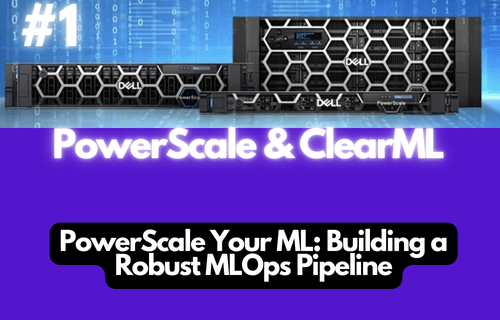
As organizations increasingly rely on (gen)AI and machine learning to drive innovation and competitive advantage, the role of data—and by extension, data management—has become paramount (was it ever not?).
Enter the modern storage administrator, now a crucial player in the MLOps ecosystem (believe me! I’m turning into one myself!)
- Data is the New Oil: (we know this) ML models are only as good as the data they’re trained on. Storage admins ensure this precious resource is available, protected, and optimized for ML workflows.
- Compliance and Governance: With increasing regulation around AI, storage admins play a key role in implementing data governance, including WORM protection and audit trails.

They (will) collaborate with data scientists to design optimal data architectures for ML workflows. They will help implement version control for datasets, be it on the array or through MLOPs tools – a critical component of reproducible ML. They ensure data lineage and provenance, crucial for regulatory compliance and model auditing to name a few, and (which we’ll get to in this series and part of my own journey) today’s storage admin is adding new tools to their arsenal:
- Proficiency in automation and Infrastructure as Code (IaC)
- Understanding of ML workflows and data requirements
- Familiarity with MLOps platforms like ClearML, MLflow, or Kubeflow
- Knowledge of data versioning tools like DVC etc

As I’m discovering, the intersection of storage, security, and AI operations creates unique challenges:
- Compliance vs. Agility: Maintaining regulatory compliance while enabling rapid experimentation
- Performance vs. Security: Balancing the high-throughput needs of AI workloads with security controls
- Integration vs. Isolation: Connecting to MLOps tools while maintaining security boundaries
- Scale vs. Control: Growing infrastructure while maintaining governance – ML-Ops tools shine here obviously – but one has to watch data sprawl as datasets are copied forward and back to worker nodes and central servers file servers- necessitating the need of a proper data control strategy.

If you visit the Dell Technologies PowerScale home page you’ll be greeted by a simple marketing message “Dell PowerScale accelerates AI and Multicloud with the world’s most secure, flexible, and efficient scale-out file storage”.
A simple message, and one that has become a bit of an ear-worm for me lately when I’m talking to customers. Most people may roll their eyes slightly at the marketing message as us techies want the details ! the how specifically.
Question – Can I use PowerScale as the backbone of my data stratey for my ML-OPs team(s) and workflows ?
- I need (1) to adhere to security best practices (security means many things as we’ll unpack later)
- I need (2) flexibility – as I’m not sure what my end state for my ML-Ops team will be i.e. workflows are constantly changing and evolving – pipeline drift is inevitable !
- I need (3) efficiency– again, as I’m not sure how my data my be used, duplicated, copied etc.
1. Security
There is a lot to unpack in that one simple word, Security – what do we mean by secure ? what parts are secure ? does it fit into a security framework ? why are marketing putting words like secure and AI together? they are two different things right ? and what persona’s does this speak too ? and…. most importantly how is it secure ?
Well, we know we have to protect our data (this is a given) and PowerSacle can certainly do this via Snapshots, SyncIQ, SnapShotIQ and its deep integration with PPDM so were good right?, but (hmmmm) I have to safeguard my data also, does PowerScale play well in the Zero Trust framework , I need End-to-End Encryption to safeguard data both at rest and during transit, Access Control and Authentication, Auditing and Monitoring, Kerberos Authentication etc, etc

When Dell tells us that “PowerScale protects your AI models and algorithms,” they’re touching on something extremely important. In an era where AI models can be worth millions and datasets are crown jewels, the storage administrator has evolved from a capacity manager to a guardian of digital assets. But what does this really mean in practice?
2. Flexibility
PowerScale’s flexibility in the AI realm centers on its comprehensive multiprotocol support, offering native S3 access for AI/ML workflows alongside traditional NFS/SMB protocols with simultaneous data access capabilities. This flexibility extends through its seamless scalability from terabytes to petabytes, supporting growing AI model sizes without disruption. The platform adapts performance through all-flash to hybrid tiers with automatic data tiering optimized for both training and inference workloads. Its integration capabilities span container support, cloud connectivity, and API-driven management – All of this will become important in our series as again, as the ML-Ops Data Management architecture may be constantly changing.
3. Efficiency
PowerScale’s deduplication and compression capabilities significantly reduce storage footprint, particularly valuable for managing multiple iterations of AI models and training datasets. The architecture’s distributed nature enables efficient data access and processing across nodes, minimizing data movement and reducing network overhead. This efficiency extends to data protection, with intelligent snapshots and replication that optimize storage utilization while maintaining data integrity for AI workloads.
Why This Series (May) Matter To You
I could create a (relatively!) straightforward blog around the various features i just outlined that PowerScale brings to the table. In a nutshell PowerScale has you covered, But I wanted to draft up a series to mirror my own journey through this – Which is simple at its core – Create a Secure, Flexible and efficient MLOps Pipeline Backet by PowerScale – After all its its right there in the Marketing Message (see what I did there!)
PowerScale’s marketing isn’t just a checkbox—it’s a framework, a philosophy, and increasingly, a regulatory requirement. As organizations rush to implement AI capabilities, they’re discovering that security, flexability, efficiency isn’t an afterthought—it’s the foundation everything else builds upon.

One can think of MLOps extending a traditional DevOps workflow by introducing specialized workflows essential for machine learning systems. While DevOps focuses primarily on code-to-deployment pipelines with testing and monitoring, MLOps adds comprehensive data engineering pipelines for data collection, validation, and feature engineering, along with experiment management workflows for model training and optimization. It also introduces unique model management requirements, including versioning both data and models, tracking experiment metrics, and monitoring model performance in production. MLOps further expands deployment considerations to include model serving infrastructure, inference optimization, and continuous monitoring for data drift and model degradation. These additional workflows make MLOps more complex than traditional DevOps, requiring specialized tools and infrastructure to manage the entire machine learning lifecycle from data preparation through to model deployment and retraining.

Whether you’re:
- A storage admin being asked to support AI initiatives
- An MLOps engineer looking to understand infrastructure security
- A security professional dealing with AI workloads
- Or like me, someone trying to bridge all these worlds
This series aims to provide the practical insights, technical details, and real-world examples you may need. Over the next several posts, we’ll construct a comprehensive, secure MLOps pipeline backed by PowerScale and ClearML
Our end state is to locally hosted Clear-ML Platform with ALL workflow data managed by PowerScale i.e. dataset, repo, artifacts etc – anything that you typical ML-Ops team may need i.e. pipeline artifacts and outputs, Raw dataset storage and versioning, Model artifacts and checkpoints, Experiment results and metrics, Code repositories and versioning, Training logs and metadata etc.

Logical Framework

Part 1: Infrastructure Setup
“Foundation First: Building Your PowerScale MLOps Environment”
- Access zones for ML workloads
- Network pools and SmartConnect configuration
- Dedicated NIC allocation for ML traffic
- Security baseline establishment
- Initial container host preparation
Part 2: Container Orchestration
“Orchestrating ML: Rancher and PowerScale Integration”
- PowerScale CSI driver setup
- Storage class configuration
- Dynamic volume provisioning
- Persistent volume claims for ML workloads
Part 3: MLOps Integration
“Clear as ML: Building the Complete MLOps Stack”
- ClearML server deployment on Kubernetes
- CI/CD pipeline integration
- Experiment tracking configuration
- Model registry implementation
- Container lifecycle management
Part 4: Version Control Strategy
“Snapshot Success: Advanced Version Control for ML”
- PowerScale snapshot strategy
- Integration with ClearML versioning
- Automated snapshot policies
- Version control best practices
- Container image versioning
Part 5: Data Protection
“WORM Drive: Data Integrity in ML Projects”
- WORM protection implementation
- Ransomware detection setup
- Compliance requirements
- Audit logging configuration
- Container backup strategies
Part 6: Performance Optimization
“Pipeline Power: Optimizing Your ML Infrastructure”
- Performance tuning for ML workloads
- SmartPools for ML data tiering
- Monitoring and analytics setup
- Resource allocation strategies
- Container performance optimization
Part 7: Governance & Compliance
“Govern & Comply: ML Data Governance”
- Data cataloging implementation
- Access auditing setup
- Compliance monitoring
- Data lineage tracking
- Container security compliance
Part 8: Data Management
“Data Flows: Optimizing ML Data Management”
- NFS shares with Kerberos authentication
- RDMA configuration for high-performance access
- Data lifecycle management
- Storage efficiency features
- CSI driver implementation basics
Let’s transform PowerScale’s marketing promise into a technical reality, one secure component at a time 🙂
Next up: Part 1 – “Foundation First: Building Your PowerScale MLOps Environment” – where we’ll lay the groundwork for our secure ML infrastructure.
 All things Unstructured Data
Leave a comment